
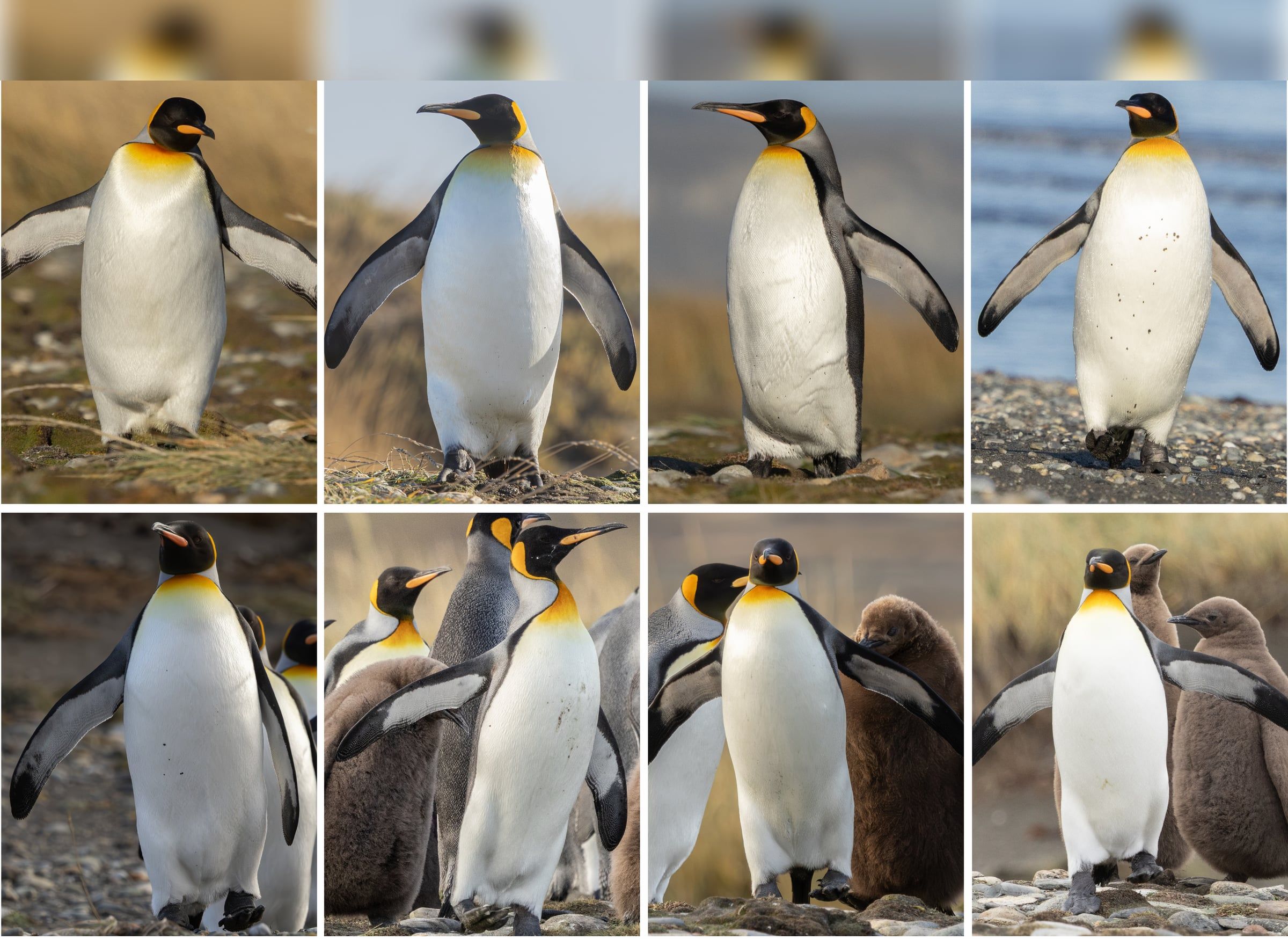
Every Penguin Has a Story
Most people see a colony of King Penguins as a sea of nearly identical birds.
We see something entirely different.
We see individuals.
Each with a unique identity.
Each with its own story.
The King Penguin Dossier is SouthWild’s pioneering photographic identification project dedicated to one of the world’s most iconic birds. Using the naturally occurring black-and-white patterns hidden beneath each bird’s wings, we are building one of the world’s first long-term databases capable of recognizing individual wild King Penguins without capturing, tagging, or disturbing them.
The project represents the newest chapter in a scientific philosophy that SouthWild has been developing for more than four decades: every wild animal is an individual, and every individual has a story worth understanding.
A Legacy That Began with Macaws
The King Penguin Dossier did not begin with penguins.
Nor did it begin with Jaguars.
Its origins reach back to the Peruvian Amazon during the 1980s.
While conducting pioneering research on macaws in the Amazon rainforest, SouthWild CEO and conservation biologist Dr. Charles Munn realized that meaningful conservation requires following the lives of individual animals rather than simply counting populations.
By recognizing individual macaws year after year, researchers could establish who was married to whom and who their fledglings were, breeding success, and population density in unlogged, unhunted Amazon rainforest.
That simple idea became one of the guiding principles behind SouthWild’s conservation philosophy.
Every individual matters.
Every life tells a story.
From Macaws to Jaguars
More than two decades later, that same philosophy inspired the creation of the Jaguar Dossier.
Since 2006, SouthWild has photographed and identified individual wild Jaguars throughout Jaguarland using their unique face spots and rosette patterns.
Today, the Jaguar Dossier has become one of the world’s longest-running photographic identification projects for wild Jaguars, documenting generations of animals, family lineages, territories, and behavioral histories.
Visitors no longer simply see “a Jaguar.”
They meet Courtney, Amber, Nels, Lisa, Tina, and hundreds of other individuals whose stories continue to unfold season after season.
Recognizing individual Jaguars transformed wildlife tourism into something far more meaningful.
It became a living archive of one of the world’s most extraordinary predator populations.
A New Discovery Beneath the Wings
In September 2024, while photographing King Penguins at Bahía Inútil, Tierra del Fuego, Ms. Javiera Vargas and Dr. Charles Munn noticed something unexpected.
The intricate black-and-white patterns beneath each penguin’s wings appeared remarkably different from one bird to another.
The observation immediately raised an intriguing question.
Could these patterns function like fingerprints?
If so, every King Penguin could potentially be recognized throughout its lifetime using nothing more than photographs.
That simple observation marked the beginning of the King Penguin Dossier.
Nature’s Own Fingerprint
Every Jaguar possesses unique rosette patterns.
Every Humpback Whale has a unique tail.
Every Whale Shark carries its own constellation of spots.
Our research now indicates that every King Penguin also possesses a unique natural signature.
The transition lines between black and white feathers, combined with the arrangement of larger dark patches across the underside of the wings, create a pattern unlike any other bird.
After analyzing more than 200,000 photographs, our research has demonstrated that these markings remain stable over years and appear to be permanent throughout an individual’s life.
Nature had already created the perfect identification system.
We simply learned how to read it.
Building the King Penguin Dossier
Developing the King Penguin Dossier has required an extraordinary scientific effort.
Since September 2024, SouthWild researchers led by Javiera Vargas have:
- Photographed more than 200,000 images.
- Dedicated approximately 200 person-days in the field documenting penguins.
- Invested another 200 person-days analyzing photographs.
- Successfully identified more than 350 individual King Penguins.
Every season expands the archive.
Every photograph becomes another piece of an ever-growing natural history database.
A Surprising Discovery
One of the project’s earliest findings challenged previous assumptions about the colony.
Although Bahía Inútil currently supports only about 90 resident breeding adults, the King Penguin Dossier has already documented more than 350 different individuals.
Most of these birds are not permanent residents.
Instead, they are subadults briefly visiting the colony before continuing their journeys throughout the Southern Ocean.
Without recognizing individuals, this remarkable pattern would have remained invisible.
The project is already providing new insights into penguin movements, population dynamics, and the role of Bahía Inútil within the broader Southern Ocean ecosystem.
Conservation Without Disturbance
Traditional wildlife research often depends on physical bands, transmitters, tags, or handling animals directly.
The King Penguin Dossier follows a different philosophy.
Every identification is made entirely through photography.
No bird is captured.
No bird is handled.
No bird is marked.
No bird even knows it is being studied.
The colony continues behaving naturally while every observation contributes to scientific knowledge.
It is conservation through observation rather than intervention.
Artificial Intelligence: The Next Chapter
Identifying several hundred penguins manually is possible.
Identifying thousands is another challenge altogether.
Future colonies, including the spectacular Volunteer Point colony in the Falkland Islands, contain thousands of King Penguins that may each possess unique underwing patterns.
Analyzing every photograph manually would require years of work.
SouthWild is therefore developing the next stage of this project through Artificial Intelligence or perhaps a small human army of analysts capable of recognizing individual penguins from their natural wing patterns.
The same technology that transformed facial recognition in humans now has the potential to revolutionize wildlife research while remaining completely non-invasive. Until we have an AI that works well to speed up the analysis, we may have to rely on a set of 10 analysts who spend many hours each day sorting photos and comparing.
The Evolution of SouthWild’s Wildlife Dossiers
The King Penguin Dossier is not an isolated project.
It represents the latest evolution of a scientific philosophy developed over more than forty years.
What began with macaws in the Amazon evolved into Jaguars in the Pantanal and now continues with King Penguins in Tierra del Fuego.
Each project builds upon the same simple principle:
Every individual has a unique identity.
Every identity tells a story.
Every story strengthens conservation.
SouthWild Wildlife Dossiers
1980’s and 1990’s | Macaw Individual Monitoring
The foundation of SouthWild’s philosophy of recognizing individual wild animals through long-term field research in the Peruvian Amazon.
2006-2026 | Jaguar Dossier
The world’s longest-running photographic identification projects for wild Jaguars, documenting generations of individually-recognizable cats throughout Jaguarland.
2024 | King Penguin Dossier
A pioneering photographic identification project demonstrating that individual King Penguins can be recognized through their unique underwing plumage patterns.
Tomorrow, many more species may become part of SouthWild’s growing Wildlife Dossiers.
Why Individual Identification Matters
Knowing that a bird belongs to a species is valuable.
Knowing which bird it is changes everything.
Individual identification allows scientists to answer questions that would otherwise remain impossible.
- How long does each penguin live?
- How often does it return?
- When does it begin breeding?
- What happens to year-old birds when they go to sea (their wing patterns are set and unique before they go to sea for the first time).
- How far does it travel across the Southern Ocean?
- How do environmental changes affect survival?
- Which individuals become long-term residents?
Every identified penguin represents another piece of a much larger puzzle.
Every answer improves conservation.
Every Penguin Has a Story
Standing among thousands of King Penguins, it is easy to believe they all look alike.
The King Penguin Dossier reveals a different reality.
Every bird is unique.
Every photograph preserves an identity.
Every observation advances science.
Every discovery strengthens conservation.
From the rainforests of the Amazon to the wetlands of the Pantanal and the windswept shores of Tierra del Fuego, SouthWild continues to demonstrate that the future of conservation begins by recognizing the value of every individual animal.
Because every Penguin has a story.
And every story deserves to be remembered.