Creating Nature's Great Fortresses
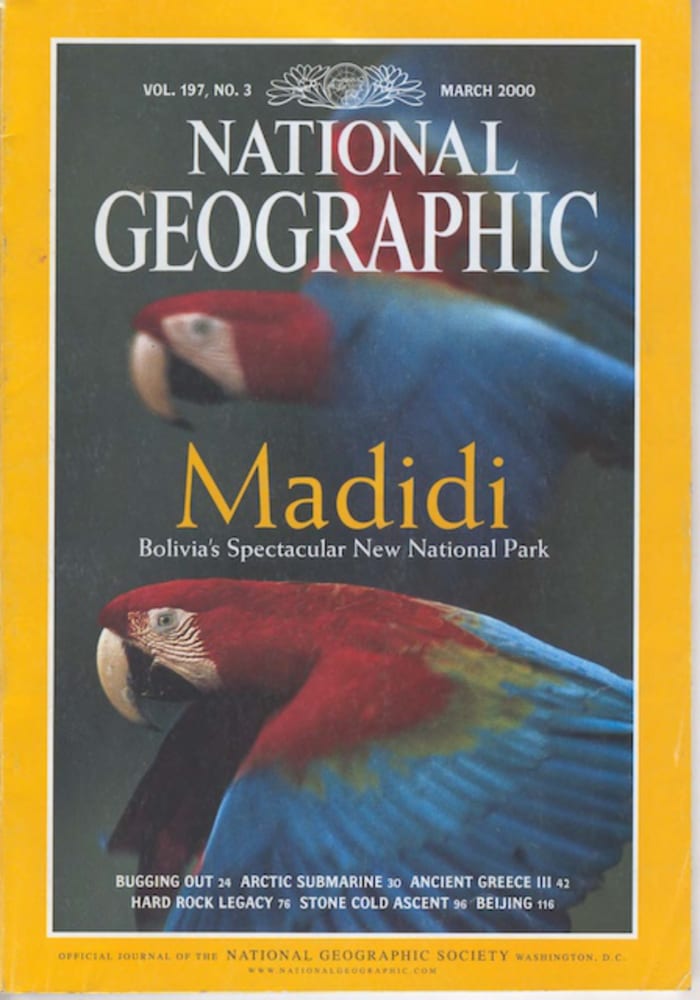
National Geographic’s cover story, Madidi: Bolivia’s Spectacular New National Park, written by Steve Kemper and illustrated with Joel Sartore’s remarkable photography, revealed to the world an extraordinary wilderness that, until then, remained largely unknown outside scientific and conservation circles.
For SouthWild, however, this story represents far more than a magazine article.
It captures one of the defining chapters in the conservation journey of Dr. Charles A. Munn III, documenting how decades of scientific research evolved into one of the most ambitious landscape conservation initiatives ever undertaken in South America.
From Macaws to Entire Ecosystems
By 2000, Charles Munn had already earned international recognition through his pioneering studies of wild macaws and park creation in the Peruvian Amazon.
Beginning in 1983, his long-term research transformed scientific understanding of macaw breeding biology, clay lick behavior, social organization, feeding ecology, seasonal movements and conservation needs.
His discoveries helped establish one of the world’s earliest successful models of conservation through ecotourism and were featured on the cover of National Geographic in the landmark 1994 article Macaws: Winged Rainbows.
But Charles understood that protecting individual species was only the beginning.
To secure the future of wildlife, entire ecosystems had to be preserved.
Madidi became the next chapter of that vision.
A Government Invitation
As described in the National Geographic article, Charles was working with the Wildlife Conservation Society (WCS) in the Peruvian Amazon, when, in 1992, the Bolivian government invited him to help redesign and expand Bolivia’s national park system.
Working alongside Bolivian authorities, scientists, conservation organizations and local communities, Charles helped shape one of the most ambitious protected area initiatives ever undertaken in the Amazon.
Together with renowned Bolivian conservationist Rosa María Ruiz, he made multiple visits to one of the least-known regions of the Amazon Basin to create a New-Jersey-sized national park, hoping to implement protection before loggers and hunters reached the area.
Their expeditions crossed remote valleys, rivers, cloud forests and Indigenous territories using virtually every means of transportation available:
- Hiking for days through mountainous terrain, including a 15,000-foot-high mountain pass.
- Traveling by mule from high elevation Andean grasslands, elfin forests, cloud forests, and then down through dry forests of rainshadow valleys and then to lowland rainforests.
- Navigating rivers by inflatable raft and motorized dugout canoe.
Just as importantly, they met with local families, indigenous leaders and village communities throughout the region, recognizing that successful conservation would ultimately depend upon the people who called these forests home.
Discovering One of Earth’s Richest Landscapes
National Geographic describes Madidi as one of the most extraordinary protected areas on the planet.
The park stretches from glaciers rising above 19,000 feet (5,800 meters) in the Andes to tropical Amazonian rainforest, encompassing approximately 4.7 million acres (1.9 million hectares) across an astonishing diversity of ecosystems.
Within a single protected landscape lie:
- High Andean peaks.
- High Andean grasslands.
- Elfin forests.
- Cloud forests.
- Dry inter-Andean rainshadow forests.
- Lowland tropical rainforests.
- Lowland, tropical pampas.
- Montane and lowland rivers.
- Countless ecological transition zones.
This extraordinary variation in altitude and habitat creates one of the highest concentrations of biodiversity found anywhere on Earth.
At the time of publication, the article reported that Madidi contained approximately:
- 700 of the world’s 11,000 bird species, despite occupying only about 0.1% of South America’s land area.
- Nearly 300 mammal, reptile, and amphibian species.
- Many thousands of plant species.
- Innumerable insects.
- Many organisms still unknown to science.
Subsequent scientific research has only reinforced Madidi’s reputation as one of the world’s greatest biodiversity hotspots.
Expanding the Vision
Perhaps the article’s most remarkable revelation concerns the park’s final size.
According to National Geographic, Bolivia initially planned to protect only about 125,000 acres.
Charles Munn, Rosa María Ruiz and their colleagues believed this would leave much of the region’s extraordinary ecological wealth unprotected.
Rather than preserving isolated fragments of habitat, they advocated protecting entire interconnected ecosystems.
Their vision prevailed.
Madidi ultimately expanded to approximately 4.7 million acres, making it nearly 38 times larger than the original proposal and creating one of the largest protected landscapes in South America.
More importantly, Madidi did not stand alone.
Together with neighboring protected areas and Indigenous territories in Bolivia and Peru, it became part of one of the largest continuous conservation landscapes on Earth, safeguarding vast ecosystems that allow wildlife to move, evolve and thrive across international borders.
It remains one of the most significant conservation achievements in modern South American history.
Conservation Through Opportunity
One of the article’s most enduring messages is that conservation cannot succeed by protecting forests alone.
It must also create opportunities for the people who depend upon them.
Throughout the expedition, Charles and Rosa visited remote villages where they met with indigenous and rural communities to discuss a radically different future.
Instead of relying primarily on logging, commercial hunting or wildlife trade, healthy forests could generate sustainable income through responsible ecotourism.
The article documents community meetings where they discussed:
- Wildlife guiding.
- Locally-owned ecolodges.
- Transportation.
- Hospitality.
- Handicrafts.
- Education.
- Long-term employment.
Rather than excluding local communities from conservation, Charles believed they should become its greatest beneficiaries.
This philosophy would later become the defining principle of SouthWild:
Wildlife is worth more alive than dead.
Tourism as a Conservation Strategy
The National Geographic expedition follows Charles as he evaluates locations that could eventually become conservation-based tourism destinations.
These projects were never envisioned simply as places to accommodate visitors.
They were conceived as engines of conservation.
Every lodge would help:
- Generate sustainable employment.
- Reduce pressure from illegal logging.
- Discourage wildlife hunting.
- Finance conservation.
- Strengthen local economies.
- Create long-term incentives to keep forests standing.
The article highlights projects such as Chalalán, where the local indigenous community of San José de Uchupiamonas became owners and operators of their own ecolodge, demonstrating that tourism could directly support both conservation and local prosperity.
This model would later inspire conservation tourism initiatives throughout the Amazon Basin and eventually become one of the defining characteristics of SouthWild’s own approach to conservation travel.
The Macaws Never Left the Story
Although Madidi is the central focus of the article, the macaws remain an enduring symbol throughout the narrative.
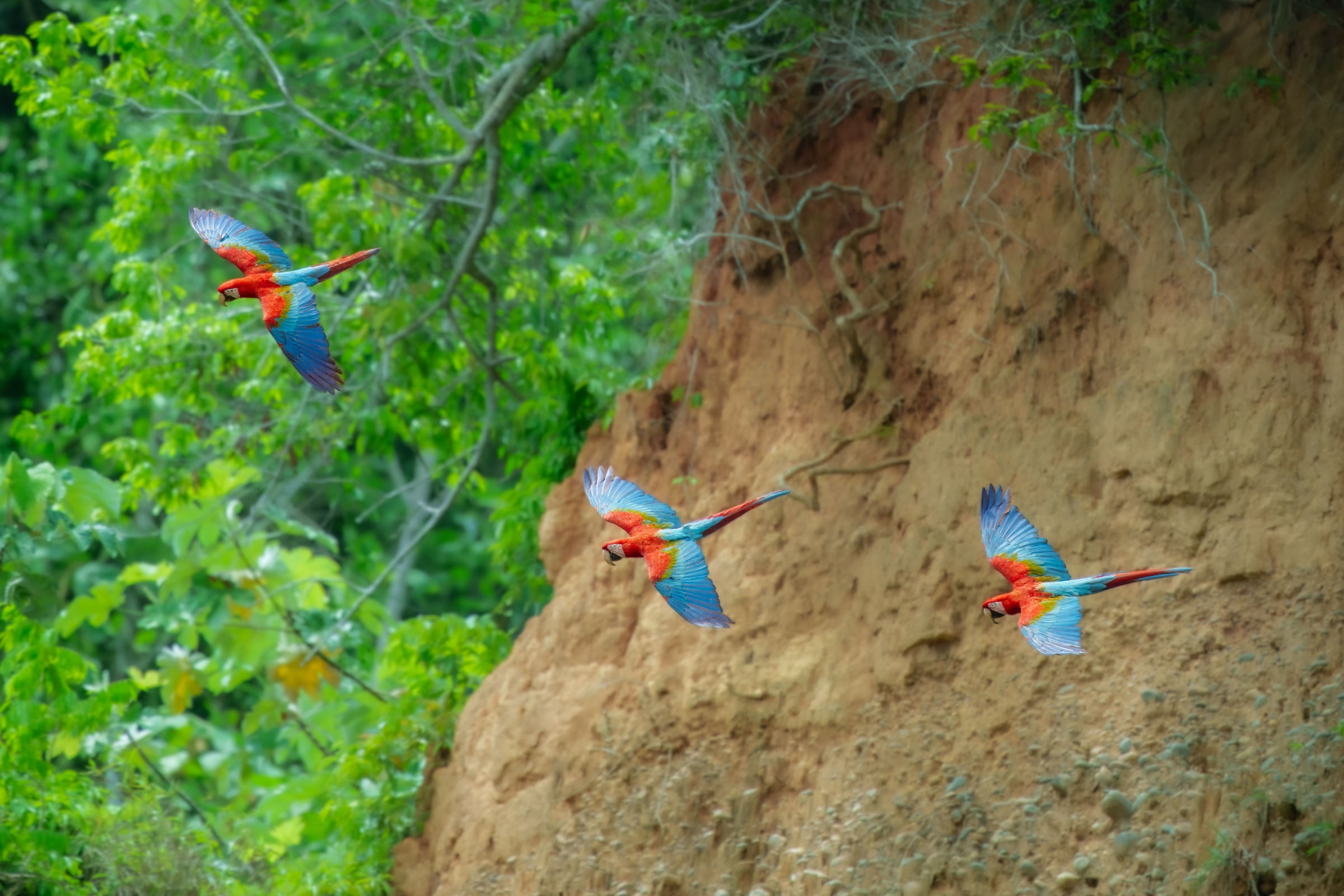
Joel Sartore’s photographs feature spectacular Red-and-Green Macaws soaring next to the 300-foot-tall sandstone cliffs where they have nested for countless generations.
Charles explains that these cliffs represent one of the finest places anywhere in South America to observe wild macaws.
The symbolism is unmistakable.
The conservation philosophy first developed through decades of macaw research had expanded from protecting the three large macaws of the western Amazon rainforest to safeguarding entire ecosystems.
What began with macaws had become a blueprint for protecting millions of acres of wilderness.
Facing Real Threats
The article also documents the enormous challenges confronting Madidi at the time.
Among them were:
- Illegal mahogany logging.
- Commercial bushmeat hunting.
- Wildlife trafficking.
- Proposed hydroelectric dam.
- Expanding infrastructure.
- Limited government resources to monitor and protect the area.
- Widespread rural poverty.
Rather than framing conservation as a conflict between people and nature, Charles consistently argued that protecting wildlife would only succeed if conservation improved local livelihoods.
Communities that earned their future from healthy forests would have the strongest incentive to protect them for generations to come.
A Legacy That Lives On
What National Geographic presented to the world in March 2000 was far more than a spectacular new national park.
It was the story of a conservation philosophy that continues to shape SouthWild today.
The article documents Charles Munn’s evolution from pioneering macaw scientist to one of the architects of landscape-scale conservation in the Americas.
Across the continent, the same guiding principles first demonstrated through his work in Peru and Bolivia continue to inspire SouthWild’s conservation initiatives.
From the cutting-edge macaw research that transformed our understanding of tropical ecology, to the creation of one of the world’s largest protected landscapes, to the development of conservation tourism as a force for protecting nature, the mission has remained remarkably consistent.
Today, that legacy lives on across the Amazon, the Andes, the Pantanal and beyond through initiatives such as Jaguarland, the Jaguar Dossier and the King Penguin Dossier.
Each reflects the same enduring conviction:
Conservation is most successful when wildlife becomes more valuable alive than lost.
For more than four decades, that idea has guided Charles Munn’s work.
Today, it continues to guide every SouthWild journey.